
Understanding Probate Services, Professional Fiduciary Responsibilities, and Estate Administration in California
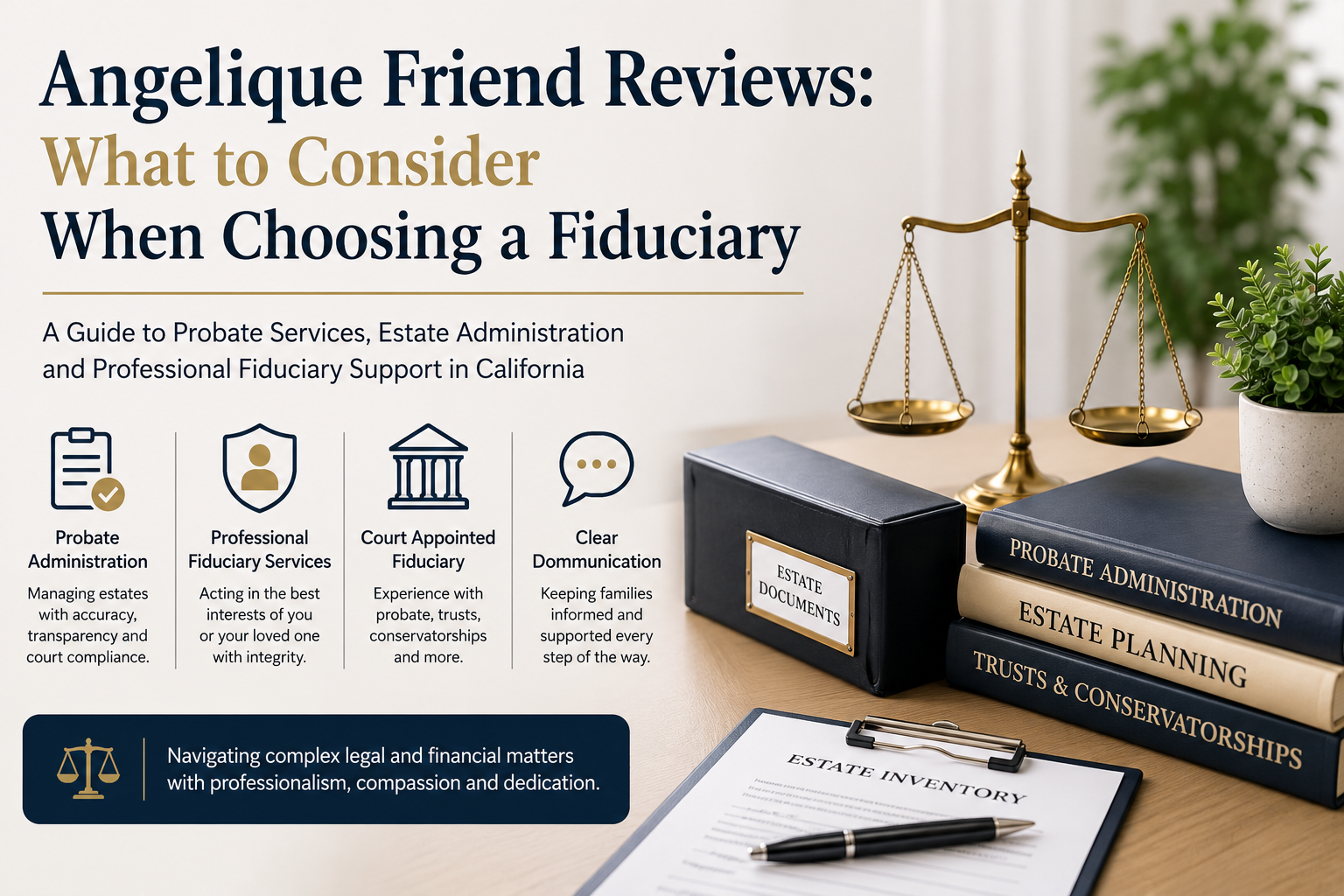
When families begin searching for Angelique Friend Reviews, they are often facing one of the most challenging periods of their lives. Probate is rarely something people plan for, and when it becomes necessary, emotions, legal requirements, financial responsibilities, and family expectations often intersect. During these moments, selecting the right professional to help administer an estate becomes an important decision.
Many people searching for Angelique Friend Probate are not simply looking for opinions. They are looking to understand the role of a professional fiduciary, how probate administration works, what qualities distinguish an experienced fiduciary, and what factors should be considered before entrusting someone with the responsibility of managing an estate or trust.
Choosing a fiduciary is very different from choosing a contractor, financial advisor, or attorney. A fiduciary is legally obligated to act in the best interests of another person or estate. This responsibility requires honesty, transparency, organization, and compliance with California law. Because of these responsibilities, many families spend considerable time researching professionals, reading reviews, understanding qualifications, and asking thoughtful questions before making a decision.
This guide explores what families should know when researching Angelique Friend Reviews, explains the responsibilities of professional fiduciaries, discusses the probate process in California, and outlines practical considerations when evaluating any fiduciary who may assist with estate administration.
Rather than relying solely on opinions or isolated experiences, understanding the broader responsibilities of probate administration can help families make informed decisions based on their own needs and circumstances.
Understanding the Role of a Professional Fiduciary
Before evaluating any fiduciary, it helps to understand what the profession actually involves.
A professional fiduciary is someone who is appointed to manage financial or personal affairs for another individual or estate. Depending on the circumstances, a fiduciary may serve as:
- Trustee
- Executor
- Estate Administrator
- Conservator
- Agent under Power of Attorney
- Court-Appointed Fiduciary
Each role carries significant legal obligations.
Unlike family members serving informally, professional fiduciaries are expected to maintain accurate records, preserve estate assets, communicate with beneficiaries, comply with court requirements, and make decisions that prioritize the interests of the estate rather than personal preferences.
Because probate often involves multiple parties—including heirs, attorneys, financial institutions, accountants, and the court—a fiduciary must coordinate information while maintaining impartiality throughout the administration process.
This level of responsibility explains why many people researching Angelique Friend Probate want to understand the experience and approach of the fiduciary they may work with.
Why Do People Search for Angelique Friend Reviews?
Whenever someone searches for a professional by name, they are usually trying to answer several important questions.
These often include:
- Does this person have relevant experience?
- What services are offered?
- How does the probate process work?
- What should I expect during estate administration?
- Is the fiduciary knowledgeable about California probate law?
- How is communication handled?
- What qualities are important when choosing someone to oversee an estate?
Searching for Angelique Friend Reviews is part of a broader effort to understand whether a fiduciary’s professional background aligns with the needs of a specific estate.
Reviews can offer insight into individual experiences, but they represent only one piece of the overall picture. Every probate case is unique, and outcomes often depend on factors such as estate complexity, court timelines, family dynamics, creditor claims, tax considerations, and legal requirements rather than the actions of a single individual alone.
For this reason, it is helpful to evaluate both publicly available information and the fiduciary’s professional qualifications before making any decisions.
Understanding California Probate
Probate is the legal process through which a deceased person’s estate is administered.
Its purpose is to ensure that:
- Assets are identified
- Debts are addressed
- Taxes are paid
- Creditors receive appropriate notice
- Property is distributed according to the will or California law
Although probate is often viewed as simply “transferring assets,” the actual process is much more detailed.
The court may require documentation related to:
- Real estate
- Bank accounts
- Investment portfolios
- Retirement accounts
- Business interests
- Personal property
- Outstanding liabilities
- Estate inventories
- Accounting reports
A fiduciary overseeing probate administration must organize this information while complying with statutory deadlines and court procedures.
This explains why many estates benefit from experienced administration, especially when significant assets or multiple beneficiaries are involved.
What Does Probate Administration Actually Involve?
Many people are surprised by the amount of work involved in probate.
Estate administration commonly includes:
Identifying Estate Assets
A fiduciary begins by identifying every asset belonging to the estate.
This may include:
- Homes
- Rental properties
- Commercial buildings
- Investment accounts
- Savings accounts
- Stocks
- Bonds
- Vehicles
- Jewelry
- Business ownership interests
- Digital assets
- Personal collections
Accurate inventories help establish the overall value of the estate and ensure appropriate administration.
Protecting Estate Property
Until probate concludes, estate assets must often be preserved.
Responsibilities may include:
- Securing vacant property
- Maintaining insurance
- Coordinating repairs
- Managing utility payments
- Preventing unnecessary losses
- Monitoring financial accounts
Preserving estate value protects the interests of beneficiaries while complying with fiduciary responsibilities.
Communicating With Beneficiaries
One of the most important responsibilities during probate is communication.
Beneficiaries often have questions regarding:
- Probate timelines
- Required documentation
- Court hearings
- Asset distributions
- Estate expenses
- Outstanding debts
Clear communication helps reduce misunderstandings and promotes transparency throughout the administration process.
Working With Attorneys
Although fiduciaries oversee administration, they frequently work alongside probate attorneys.
Attorneys assist with:
- Court filings
- Legal interpretation
- Probate petitions
- Notices
- Hearings
- Compliance with California probate statutes
A collaborative relationship between legal counsel and fiduciary professionals helps ensure procedural requirements are satisfied.
Qualities Families Often Look for in a Professional Fiduciary
Every estate presents different challenges.
However, families commonly value similar qualities when evaluating fiduciaries.
Organization
Probate generates substantial documentation.
A fiduciary may oversee:
- Financial statements
- Court filings
- Property records
- Tax information
- Creditor correspondence
- Banking records
- Receipts
- Estate accounting
Organization helps reduce errors while improving transparency.
Communication
Probate can take months or, in some cases, more than a year.
During this period, beneficiaries appreciate:
- Regular updates
- Prompt responses
- Clear explanations
- Professional communication
Effective communication often reduces uncertainty during emotionally difficult circumstances.
Neutral Decision-Making
Family disagreements occasionally arise during probate.
Because fiduciaries have legal obligations to the estate rather than individual beneficiaries, maintaining neutrality is an essential aspect of the role.
Objective decision-making helps preserve fairness throughout the administration process.
Attention to Detail
Probate administration involves numerous deadlines and financial responsibilities.
Missing required documentation or overlooking financial records may create unnecessary complications.
Attention to detail supports accurate administration and regulatory compliance.
Professional Accountability
Professional fiduciaries operate under legal standards that require acting in the best interests of those they serve.
Responsibilities generally include:
- Maintaining accurate accounting
- Avoiding conflicts of interest
- Protecting estate assets
- Acting prudently
- Following court orders
- Complying with applicable California laws
These obligations help establish accountability throughout the probate process.
Why Experience Matters During Probate
Experience does not eliminate the complexity of probate, but it can contribute to a smoother administration process.
Experienced fiduciaries often become familiar with:
- Probate procedures
- Estate accounting
- Asset valuation
- Property management
- Court documentation
- Financial reporting
- Conservatorships
- Trust administration
- Beneficiary communication
Each estate is different, but familiarity with common probate procedures may help anticipate administrative requirements and coordinate effectively with attorneys, accountants, financial institutions, and the court.
For families researching Angelique Friend Probate or evaluating any professional fiduciary, understanding this broader context can be just as important as reading individual reviews. Probate is a legal and administrative process that benefits from organization, communication, and a clear understanding of fiduciary responsibilities.
Angelique Friend Reviews: Looking Beyond Ratings When Evaluating a Professional Fiduciary
When people search for Angelique Friend Reviews, they are often hoping to find reassurance before making an important decision. Reviews can offer insight into individual experiences, but they are only one part of the overall evaluation process. Every probate estate is different, every family dynamic is unique, and every court-supervised matter presents its own challenges.
Unlike businesses that provide one-time services, a professional fiduciary may remain involved with an estate or conservatorship for months or even years. During that time, they must navigate legal requirements, financial responsibilities, beneficiary communication, court reporting, and ongoing administrative tasks. As a result, the experience of one family may differ significantly from another based on the complexity of the estate rather than the performance of the fiduciary alone.
For this reason, families researching Angelique Friend Probate should consider multiple factors when evaluating any professional fiduciary rather than relying solely on ratings or isolated comments.
Some of the most important considerations include:
- Professional experience
- Knowledge of California probate procedures
- Communication style
- Organization and record-keeping
- Transparency
- Ability to work with attorneys and financial professionals
- Responsiveness to questions
- Commitment to acting in the best interests of the estate
These qualities often have a greater impact on the probate process than any single online review.
Understanding Trust Administration
Not every estate goes through probate. Many individuals establish living trusts to simplify the transfer of assets after death. However, trust administration still requires careful management and adherence to legal obligations.
A fiduciary serving as a trustee or assisting with trust administration may be responsible for:
- Reviewing trust documents
- Identifying trust assets
- Notifying beneficiaries
- Managing investments
- Paying valid debts and expenses
- Maintaining accurate financial records
- Preparing trust accountings
- Distributing assets according to the trust instructions
Although trust administration is generally less court-intensive than probate, it still requires diligence, organization, and careful attention to detail.
Families searching for Angelique Friend Probate may also be interested in understanding trust administration because the two services often overlap depending on how an estate has been planned.
Conservatorships and Fiduciary Responsibilities
Professional fiduciaries may also serve in conservatorship matters.
A conservatorship is established when an individual is unable to manage personal or financial affairs independently due to age, illness, disability, or diminished capacity.
Depending on the appointment, responsibilities may include:
Managing Finances
A fiduciary may oversee:
- Banking
- Bill payments
- Investments
- Budgeting
- Tax coordination
- Insurance matters
The goal is to preserve assets while ensuring financial obligations continue to be met.
Protecting Personal Interests
Some conservatorships involve decisions regarding:
- Housing
- Healthcare coordination
- Personal care
- Daily living arrangements
These responsibilities require sensitivity, professionalism, and a commitment to acting in the conservatee’s best interests.
Court Reporting
California conservatorships generally require periodic reporting to the court.
This often includes:
- Financial accountings
- Asset inventories
- Updates regarding the conservatee’s circumstances
- Compliance with court orders
Maintaining accurate records throughout the conservatorship helps demonstrate accountability and transparency.
Estate Administration Requires Teamwork
One misconception about probate is that a fiduciary works independently.
In reality, successful estate administration often involves collaboration among several professionals, including:
- Probate attorneys
- Certified Public Accountants
- Financial advisors
- Real estate professionals
- Insurance providers
- Investment institutions
- Court personnel
The fiduciary frequently serves as the central coordinator, ensuring that information flows efficiently between these parties while keeping beneficiaries informed about major developments.
Strong collaboration can help reduce delays and support the orderly administration of an estate.
Common Challenges During Probate
Every probate matter presents unique circumstances, but several challenges arise more frequently than others.
Family Disagreements
Even close families may disagree regarding:
- Asset distribution
- Personal property
- Estate expenses
- Interpretation of wills
- Real estate decisions
Professional fiduciaries help maintain neutrality by focusing on legal obligations and the governing estate documents.
Complex Financial Assets
Modern estates often include:
- Investment portfolios
- Retirement accounts
- Business ownership
- Cryptocurrency
- Intellectual property
- Rental properties
Managing these assets requires careful documentation and coordination with financial professionals.
Creditor Claims
California probate law requires proper handling of creditor claims.
A fiduciary may need to:
- Notify creditors
- Review submitted claims
- Coordinate payment of valid obligations
- Maintain documentation supporting estate expenses
Proper handling helps protect the estate while ensuring legal compliance.
Property Maintenance
If an estate includes real estate, someone must oversee:
- Insurance
- Security
- Repairs
- Utility payments
- Property taxes
- Maintenance
Protecting estate property helps preserve its value until distribution or sale.
Record Keeping
Throughout probate, nearly every financial transaction should be documented.
This includes:
- Bank statements
- Receipts
- Invoices
- Property expenses
- Tax documents
- Investment reports
Detailed accounting promotes transparency and may be required by the court.
Questions to Ask Before Choosing Any Professional Fiduciary
Researching Angelique Friend Reviews or any other professional fiduciary should involve more than reading online comments.
Families should consider asking questions such as:
How long have you worked in probate administration?
Experience can provide valuable familiarity with California probate procedures and estate administration requirements.
What types of fiduciary appointments do you typically handle?
Some professionals primarily administer probate estates, while others focus on conservatorships, trust administration, or court appointments.
How often do you communicate with beneficiaries?
Understanding communication expectations helps reduce uncertainty during the probate process.
How are estate records maintained?
Accurate documentation is an essential fiduciary responsibility.
What professionals do you typically work with?
Collaboration with attorneys, accountants, financial advisors, and other professionals often contributes to efficient estate administration.
How are fiduciary fees determined?
Understanding compensation helps families make informed decisions before services begin.
Characteristics Families Often Value
Although every family has different priorities, several characteristics consistently emerge when people evaluate fiduciaries.
Professionalism
Probate requires careful attention to legal responsibilities, financial accuracy, and respectful communication.
Organization
Well-organized records reduce confusion while supporting transparency.
Responsiveness
Promptly answering questions can help beneficiaries feel informed throughout the probate process.
Integrity
Fiduciaries are expected to act honestly, impartially, and in accordance with California law.
Financial Accountability
Every financial decision should be documented and supported by appropriate records.
Frequently Asked Questions
What is a professional fiduciary?
A professional fiduciary is an individual who manages financial or personal affairs on behalf of another person, trust, or estate while acting in that person’s best interests.
What does probate administration involve?
Probate administration generally includes identifying estate assets, paying valid debts, maintaining financial records, communicating with beneficiaries, and distributing property according to a will or California law.
What is trust administration?
Trust administration involves managing and distributing trust assets according to the trust document while fulfilling the trustee’s fiduciary duties.
What is a conservatorship?
A conservatorship is a legal arrangement in which a court appoints someone to manage financial or personal affairs for an individual who cannot do so independently.
Why do families hire professional fiduciaries?
Professional fiduciaries provide impartial administration, experience with estate management, and assistance navigating complex legal and financial responsibilities.
Is probate always required?
No. Some assets transfer outside probate, particularly when held in living trusts or with designated beneficiaries.
How long does probate usually take?
The length of probate depends on estate complexity, court schedules, creditor claims, and other factors. Some cases conclude within several months, while others require considerably longer.
Can a fiduciary also serve as trustee?
Yes. Depending on the circumstances, a professional fiduciary may serve as trustee, executor, administrator, conservator, or in other fiduciary capacities.
How important are communication and organization?
They are essential. Clear communication and accurate record-keeping help beneficiaries understand the probate process while supporting transparency.
How should families evaluate a fiduciary?
Families should consider experience, qualifications, communication, professionalism, organization, and publicly available information before making a decision.
Final Thoughts
Searching for Angelique Friend Reviews reflects a desire to make an informed decision during an important and often emotional time. Probate administration is about far more than paperwork—it involves protecting assets, fulfilling legal obligations, communicating with beneficiaries, and managing complex financial and administrative responsibilities.
Whether researching Angelique Friend Probate or evaluating any California professional fiduciary, families benefit from taking a thoughtful approach. Looking beyond individual reviews to consider experience, communication, organization, transparency, and fiduciary responsibilities provides a more complete picture of what to expect.
Every estate has unique circumstances, and no single review can fully represent the complexity of probate administration. Asking informed questions, understanding the fiduciary’s role, and considering professional qualifications alongside publicly available information can help families choose a fiduciary who is well-suited to their specific needs.

Connect With Us